

Award Year
Graduation Year
Department
Award Category
Biography
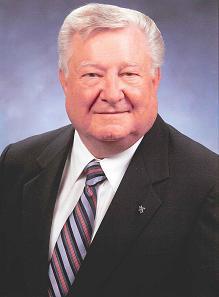
Jerry Florey’s name is engraved on the Smithsonian’s National Aviation and Space Exploration Wall of Honor. His technology has been to the moon and back many times over. In his early career, he was hired by Dieter Hutzel, who was Werner von Braun’s deputy in German rocket development before and during World War II. As a young man raised in McMinnville, Ore., Florey was a 4-sport letterman in high school and fraternity vice president at Oregon State University. He went on to become an integral part of the United State’s presence in space.
“I went to work in the rocket business,” says Florey. “There were no advanced degrees for that. I got my training in rocket science from the Peenemunde Germans. Add that to my technical degree from Oregon State and I was able to compete with engineers from some of the country’s most prestigious universities.”
Florey’s extensive career touched all aspects of space systems — rocket engines, launch vehicles, and satellites and their payloads. His experience includes business development, strategic planning, technical marketing, and extensive program engineering and technology contract management.
Florey is most proud of his involvement with the Apollo space program. “I contributed to the design and development of the nation’s first liquid hydrogen/oxygen rocket engines used on the second and third stages of the Saturn V launch vehicle that sent men to the moon,” he says. “I was on the propulsion console of all Apollo launches — but for one — at the George Marshall Space Flight Center, which provided backup support to the launch crews at Cape Canaveral (Kennedy) and the flight directors at the Houston Space Center.”
Florey also served as director and chief engineer for the Rockwell International Space and Satellite Systems Division, where he managed the engineers in all the technical disciplines. “I was heavily involved in managing resources, indirect and direct budgets, independent research and development — just busy keeping the whole operation running,” he says.
After a career in which 100-hour weeks were not uncommon, Florey still revels in the wonderment of the historic times in which he was involved in the space industry. “There is so much more to learn today than there was in the 1950s,” he says. “When I first started, engineers were king; I could speak with my NASA counterpart, and we could negotiate a change order. This is no longer true. Based upon my experience, an up-and-coming engineer should also think about an additional business degree.”
Florey is married to his college sweetheart Mary, and they enjoy extensive traveling around the world in their retirement years. “You must understand, I was working during the Cold War,” he says. “Because of the classified nature of the ‘black programs’ in which I was involved, I was discouraged from traveling outside the country.”